
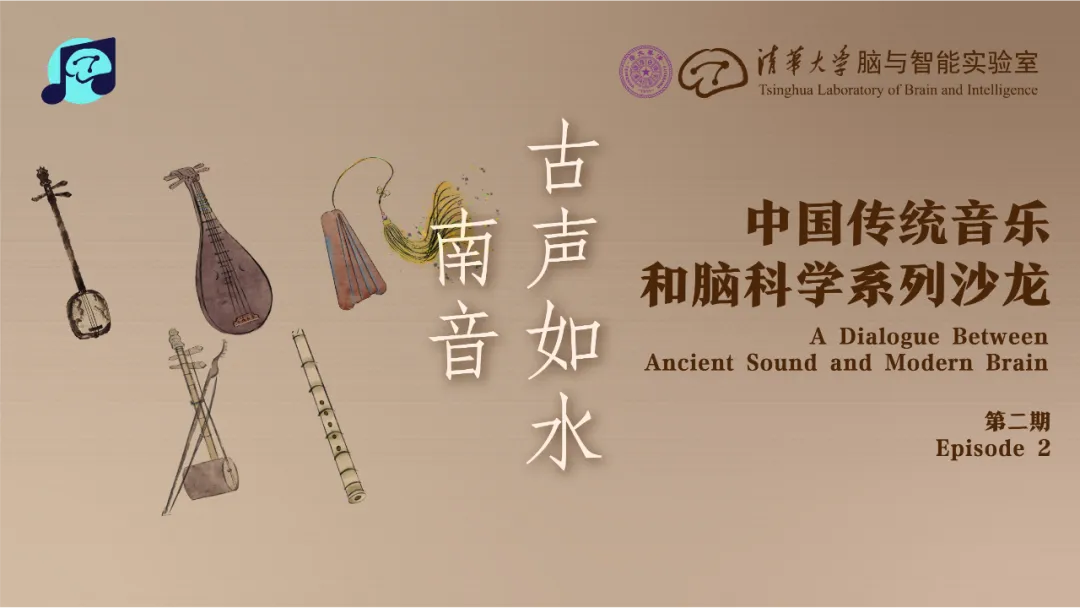
On the afternoon of November 29, 2025, ancient melodies gently flowed through the Music Auditorium of Tsinghua University Library—the cross-disciplinary dialogue “Ancient Sound Like Water,” featuring Nanyin and brain science, was held as scheduled. This was the second session of the “Traditional Music and Brain Science” salon series organized by the Tsinghua Laboratory of Brain and Intelligence.
The event was hosted by Professor Wang Xiaoqin an internationally recognized auditory neuroscientist and Director of the Tsinghua Laboratory of Brain and Intelligence. Guest speakers included:
- Chen Meier
Founder of the Han-Tang Yuefu Ensemble, key promoter of contemporary Nanyin expression - Lin Lice
Associate Professor at the China Conservatory of Music, Research Fellow at the Chinese Music Research Base - Huang Juan
Researcher in auditory and multisensory integration neuroscience, Senior Visiting Scholar at Tsinghua University - Nanyin Performance Team from Quanzhou Normal University
Zhuang Qiaolin, Chen Xinying, Lai Yiling, Chen Pengyu
From music and culture to neuroscience, the speakers jointly presented the ancient charm and contemporary inspiration of Nanyin.
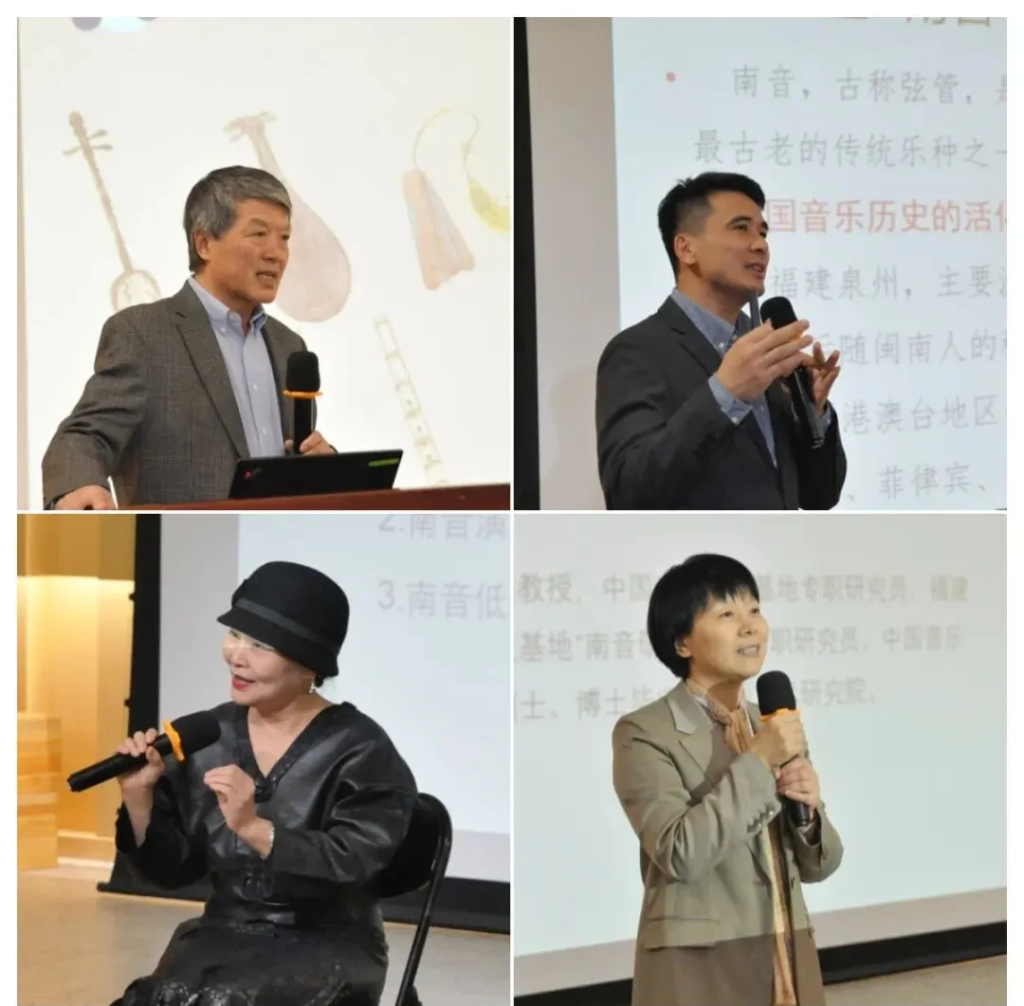
Lin Lice, Associate Professor and Nanyin researcher (top right)
Chen Meier, founder of the Han-Tang Yuefu Ensemble (bottom left); Huang Juan, neuroscience researcher (bottom right)
Nanyin: A “Living Fossil” of Chinese Music and a New Starting Point for Scientific Inquiry
At the beginning, Professor Wang Xiaoqin introduced the laboratory’s frontier research in music neuroscience, including EEG, functional near-infrared spectroscopy (fNIRS), and multimodal physiological signal acquisition. She explained how these techniques are used to explore music perception, emotional experience, interoception and relaxation responses, aesthetic processing, and other topics.
Lin Lice then provided a systematic introduction to the historical origins, musical system, and Minnan cultural background of Nanyin. He noted that Nanyin, as a highly complete ancient musical system, encompasses three major categories—“zhi, qu, pu”—and preserves ancient Chinese phonology, traditional notation, and classical instrumental structures. Its slow melodic flow and calm timbre naturally induce introspection and relaxation, revealing scientific questions yet to be explored.
Multisensory Imagery in Traditional Aesthetics: From Vocal Style to Color
In the panel discussion, music scholars and neuroscientists exchanged perspectives from cultural, aesthetic, and brain–body dimensions. Artist and Nanyin advocate Chen Meier shared her long-term work in Nanyin preservation and innovation. She emphasized that Nanyin still retains the vocal structure and performance form of the Tang and Song dynasties. Its “rigorous structure, ancient elegance, dignified character, and profound artistic conception” embody a uniquely Chinese classical musical aesthetic. She also described how the Han-Tang Yuefu ensemble integrates traditional musical techniques with classical theatrical movement, color palettes, and lighting from ancient performance traditions—together with the calm, unified mental state of performers—to form a holistic multisensory expression. This approach reflects a distinctive contemporary expression rooted in tradition: “tradition + tradition = innovation,” a Chinese classical form that is also universally resonant.
From Music to the Brain: Collective Resonance and Higher-Order Spiritual Experience
Dr. Huang Juan noted from a neuroscience perspective that the deep coordination among Nanyin performers—developed through long-term ensemble training—is a form of “musical high-level mental communication.” Their synchronization in rhythm, breathing, and intention reflects a model of collective intelligence, offering unique insights into human aesthetic experience and the social brain. She further explained that the steady sound flow, harmonious ensemble interaction, and relaxation responses of listeners involve quantifiable neural and physiological mechanisms—changes in physiological indices, brain network transitions, and mind–body regulation. These topics align with the research focus of the music neuroscience team at the Tsinghua Laboratory of Brain and Intelligence. Huang emphasized that studying aesthetic experiences—especially those difficult for AI to emulate and deeply rooted in human consciousness and emotion—is particularly valuable in an era when AI is deeply integrated into human life and creativity.
Immersive Performance: Sound Touching the Heart, Time Slows Down
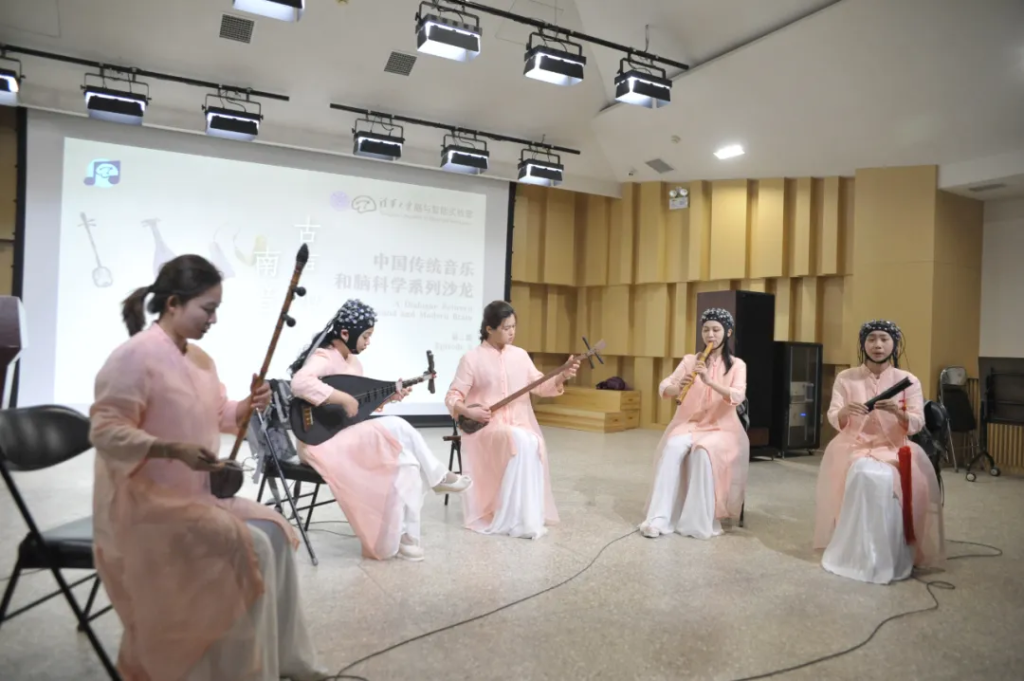
The Nanyin ensemble from Quanzhou Normal University presented an intimate, unamplified “hall-style” performance, showcasing the beauty of zhi-qu, zhi-pu, and traditional singing. In the natural acoustics of the room, the audience experienced the temporal depth and classical aesthetics of Nanyin. As the calm sound unfolded, listeners’ breathing, attention, and emotions shifted accordingly. Ancient sounds flowed like water, quietly immersing body, mind, and brain. Many attendees remarked: “My whole body slowed down,” “The music felt like it carried me into another world.”
Science in Action: Can Nanyin Be a “Natural Anxiolytic”?
As a highlight of the series, the music neuroscience team from the Tsinghua Laboratory of Brain and Intelligence conducted real-time EEG, fNIRS, and physiological signal recordings from several performers and front-row listeners, drawing strong interest from the audience. These data may inspire future research: Why does Nanyin have a significant calming effect? Could it serve as a natural “musical anxiolytic,” benefiting sleep, anxiety, or interoception regulation? Can the classical aesthetic ideal of “harmony between heaven, earth, and humanity” be quantified through modern neuroscience? The event demonstrated concrete pathways and tremendous potential for addressing these questions.
Looking Ahead: Bringing Traditional Music Into Science and Daily Life
Nanyin is not only a vital cultural heritage of China and the world but also a unique window into emotional regulation, consciousness, and mind–body mechanisms. Through the in-depth dialogue among scholars, artists, and scientists, this salon highlighted the frontier scientific value of traditional music in contemporary brain research. As an important stop in the “Traditional Music and Brain Science” series, the event advanced the three major visions proposed by the music neuroscience team of the Tsinghua Laboratory of Brain and Intelligence:
- Advancing music neuroscience research in real-world settings
- Building a localized framework of music neuroscience grounded in Chinese traditional music
- Exploring the neural mechanisms and applications of music-based therapeutic strategies
In the coming months, the series will continue with themes including literati music, Kunqu and Jiangnan Sizhu, northern sheng–guan music, and Buddhist music, exploring the deep dialogue between Chinese traditional music and contemporary brain science with the public.
Leave a Reply