
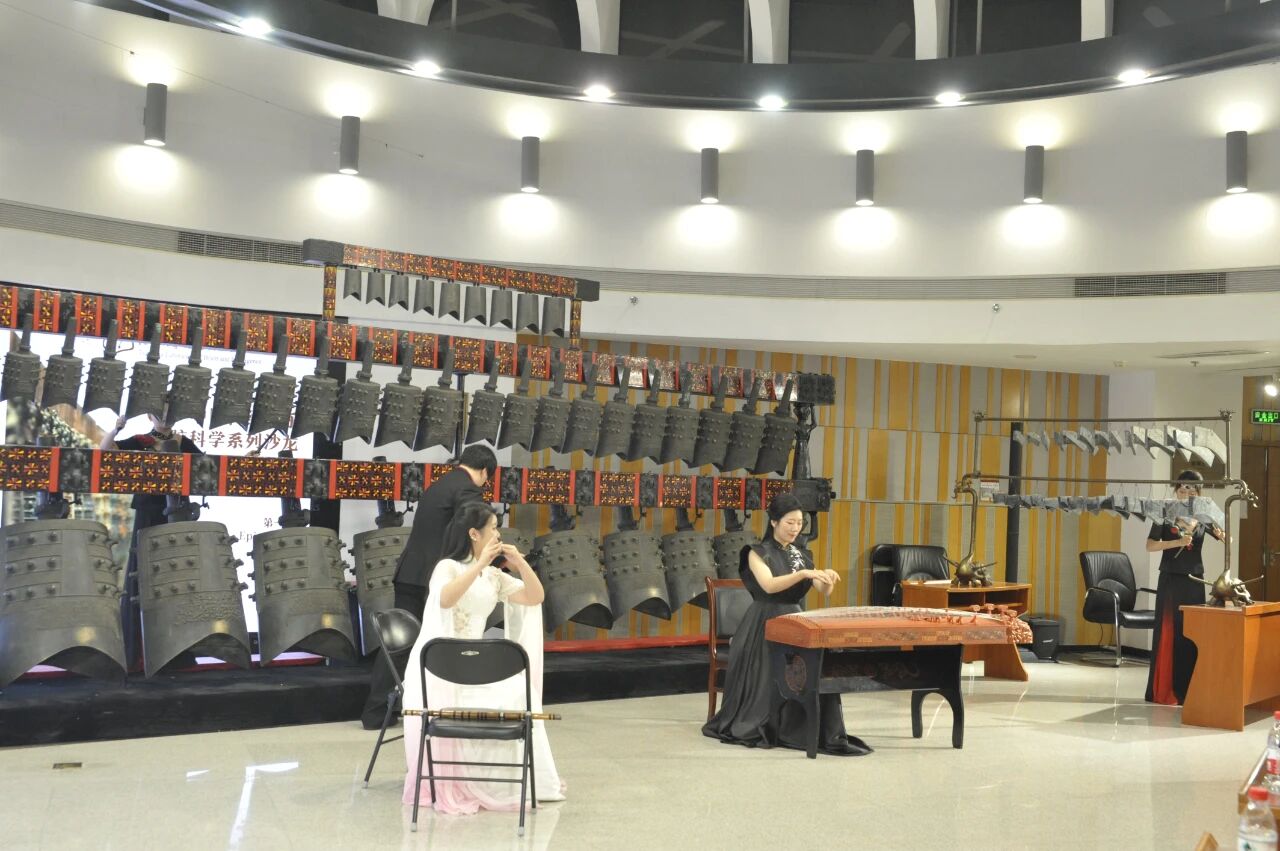
On the evening of November 1, 2025, the inaugural event of the “Chinese Traditional Music and Brain Science” dialogue salon series, hosted by the Tsinghua Laboratory of Brain and Intelligence, was successfully held on the Tsinghua University campus. Titled “Hearing the Chimes of a Millennium Ago: From the Marquis Yi of Zeng Bells to Contemporary Auditory Neuroscience,” the event brought together four experts from the fields of neuroscience, music archaeology, music performance, and cross-modal cognition for an in-depth dialogue on the intersection of ancient music and brain science. Complemented by an immersive live performance of the bianzhong (chime bells) and bianqing (stone chimes), the salon offered the audience a unique experience where science and culture resonated.
The invited guests included:
- Professor Wang Xiaoqin, Director of the Tsinghua Laboratory of Brain and Intelligence and a world-renowned auditory neuroscientist;
- Professor Wang Qinglei, Research Fellow at the Music Research Institute of the Chinese National Academy of Arts and a leading scholar in Chinese music archaeology;
- Mr. Long Wen, Lecturer at the Wuhan Conservatory of Music and a key performer with the Marquis Yi of Zeng Bianzhong Orchestra;
- Dr. Huang Juan, Senior Visiting Researcher at the Tsinghua Laboratory of Brain and Intelligence.

The salon was moderated by Dr. Huang Juan, and the dialogue was structured around four thematic modules:
Module 1: Dual Tones in a Single Bell—From Instrumental Structure to Auditory Mechanisms
Professor Wang Qinglei introduced the structural innovation of the “dual-tone” feature in the Marquis Yi of Zeng bells: through an asymmetrical ellipsoidal body and different striking points, each bell can produce two principal tones separated by approximately a major third, showcasing the high level of sophistication of pre-Qin craftsmanship and musical systems. Professor Wang Xiaoqin, from the perspective of the auditory nervous system, analyzed how the brain processes dual-tone inputs in parallel, explaining the cognitive challenges this structure poses for frequency discrimination, temporal integration, and sound source segregation.
Module 2: Shaping the Brain with Musical Scales—How Culture Trains Auditory Experience
Using the twelve-tone scale employed by the Marquis Yi of Zeng bells as an example, Professor Wang Qinglei elucidated the philosophical connotations of ancient Chinese tonal systems, contrasting them with the “harmonic expression” model of the Western twelve-tone equal temperament and pointing out that the former embodies an auditory model of “harmony between heaven and humanity.” Professor Wang Xiaoqin further explored the cultural acquisition mechanisms related to musical preference and “pitch deviation tolerance,” proposing that “what we listen to determines how we listen,” and analyzed the neural basis of “collective auditory memory.”
Module 3: Sound as Memory—How Chimes Activate Cultural Maps in the Brain
Professor Wang Qinglei pointed out that the inscriptions on the Marquis Yi of Zeng bells not only recorded pitches and functions but also constructed an early “sound memory system,” achieving the visualization, institutionalization, and materialization of sound, serving as a prototype of an ancient “sound archive.” He emphasized that the bianzhong are not just “musical instruments” but also “ritual objects,” symbolizing the unified sound standard and cultural inheritance of the pre-Qin ritual-music system. Professor Wang Xiaoqin added that the brain mechanisms of sound processing are both cross-culturally universal and culturally specific—humans share a common aesthetic appreciation for music that aligns with the encoding principles of the auditory nervous system, while the unique feelings towards ethnic music stem from cultural conditioning.
Module 4: Sound and the Body—From Ritual Music Regulation to Modern Neuromodulation
Dr. Huang Juan, drawing on research into audio-tactile integration, explained how the low-frequency resonance of the bianzhong activates the somatosensory system at the levels of skin, muscles, and internal organs, creating a whole-body audio-tactile integration experience. This physical resonance is the neurophysiological basis for inducing relaxation and meditative states. She further noted that modern research has confirmed that low-frequency rhythmic sounds can significantly activate the parasympathetic nervous system, lower heart rate, and enhance heart rate variability, thus constituting the neural mechanism of the “sound relaxation response.”
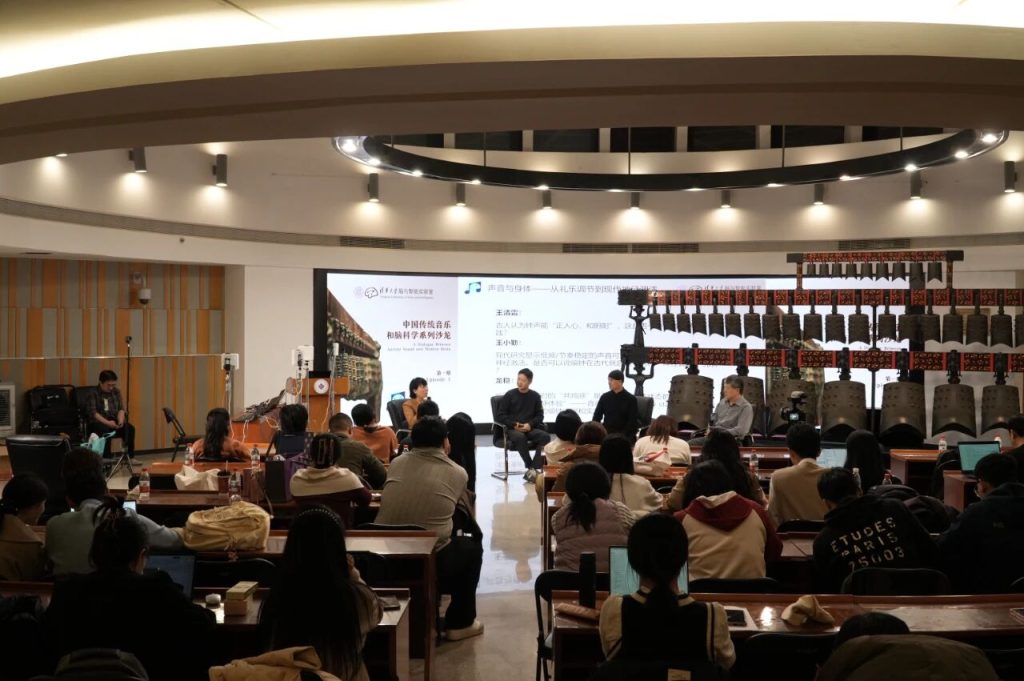
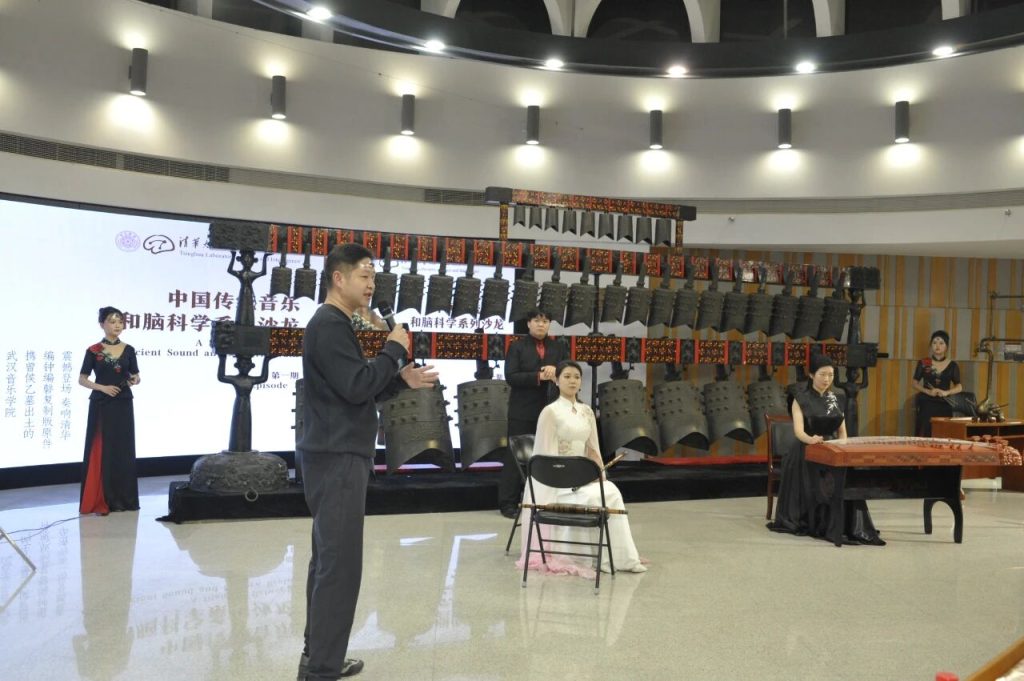
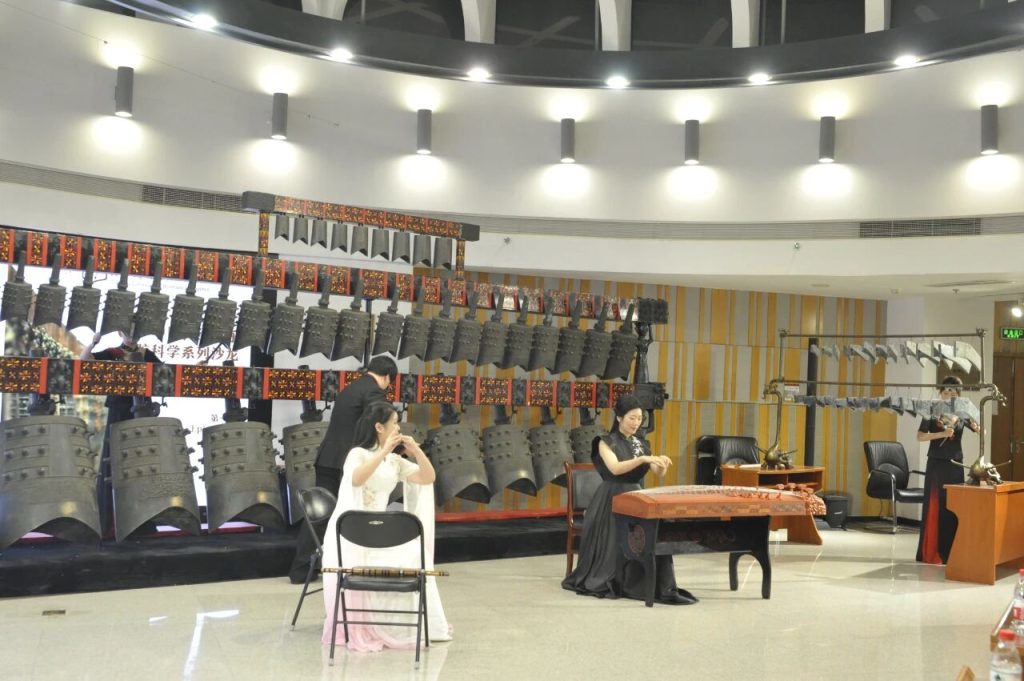
Mr. Long Wen from the Wuhan Conservatory of Music shared his unique experience from long-term performance of the bianzhong and introduced the development of bianzhong teaching and performances at the conservatory. At the conclusion of the event, faculty and students from the Wuhan Conservatory of Music performed several modern pieces live, using replicas of ancient instruments such as the Marquis Yi of Zeng bianzhong and bianqing, accompanied by flutes and se (a zither-like instrument). Five audience members and the performers wore EEG devices to record prefrontal brain signals, with the aim of analyzing attentional states and subjective experiences. After the performance, the audience engaged in a lively interaction with the guest speakers.
A Resonance Across a Millennium: The Fusion of Music, Science, and the Humanities
“Music is not just an art form, but also a scientific path to understanding the brain, constructing cognition, and connecting emotion and social interaction.” —This is the core philosophy of the Music and Brain Science team at the Tsinghua Laboratory of Brain and Intelligence.
The “Art and Science” dialogue salon series is a practical embodiment of the research philosophy of the Music and Brain Science team at the Tsinghua Laboratory of Brain and Intelligence, aiming to:
- Promote immersive, real-world music neuroscience research:
Move beyond traditional laboratory paradigms to immersive environments where musicians and audiences participate together, exploring the deep connection between subjective experience and neurophysiological states. - Establish Chinese traditional music as a key subject for neuroscience research:
Fill the long-standing gap in contemporary music neuroscience, which has often overlooked Chinese traditional musical culture, by building a localized research framework from the perspectives of tonal systems, perception, and cross-modal modeling. - Advance the scientific and application-oriented integration of music therapy:
Collaborate with musicians and clinical music therapists to build therapeutic models supported by evidence of neural mechanisms, exploring the implementation of “music-emotion-interactive intelligent systems” in scenarios such as brain-computer interfaces, home-based assistance, and rehabilitation.
This salon series focuses on “The Dialogue Between Chinese Traditional Music and Brain Science,” with subsequent events to explore themes such as Nanyin, Guqin, Kunqu Opera, Sheng and Guan music, and Buddhist music.
Through this series, we hope to build a platform for the deep intersection of art and science. We sincerely invite friends from the fields of neuroscience, performing arts, music therapy, artificial intelligence, and the humanities and social sciences to join us in exploring—making traditional music not just a cultural heritage, but an important path for us to understand the brain, understand humanity, and design the future.
- Contributed by | Huang Juan
- Editor & Layout | Gao Jing, Wang Jingyi
- Reviewed by | Wang Xiaoqin, Guan Weijie
Leave a Reply